Archaeological explorations along the North Sinai corridor unearthed two locally manufactured (fragmentary) vessels of early 19th Dynasty “beer jars” stamped with the cartouches of Seti I alongside a hieroglyph of a ship. A second example of a royal ship with the throne names of Seti I and Haremhab was recorded on an Egyptian amphora handle…
The Sinai Peninsula and its Environs: Our Changing Perceptions of a Pivotal Land Bridge Between Egypt, the Levant, and Arabia
The Sinai Peninsula has provided a continuous land bridge connecting northeast Africa and Asia, and particularly Ancient Egypt with the Levant. This paper focuses mainly upon past through recent explorations of Ancient Egypt’s Prehistoric through pharaonic interactions with the Sinai and its environs, including the Negev, and in particular considers our changing perceptions of Egyptian…
Some Remarks on the Tjemhu Libyans
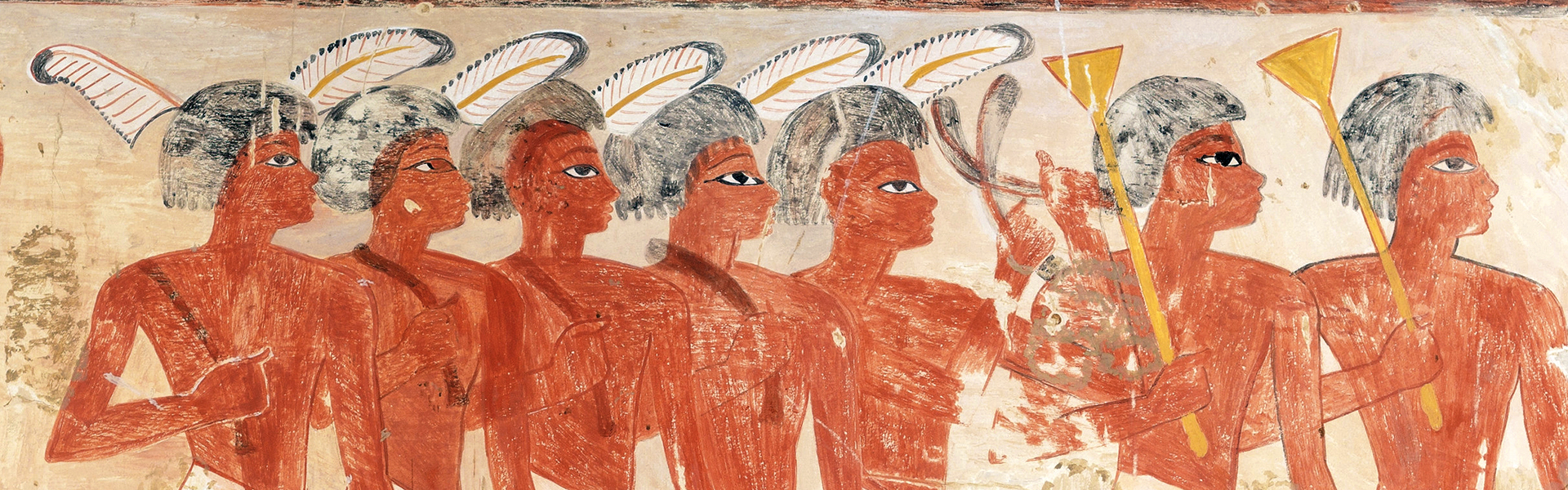
The Tjemhu-Libyans are mentioned in Egyptian sources starting with the 6th Dynasty, when they are presented in geographical proximity to the Nubians and meet the Egyptians during exploratory/trading expeditions. Later, the term “Tjemh” was used to generically indicate the Libyan-land and to indicate “the west.” Representations of Tjemhu dancers appear in Egyptian temples show the…
A Preliminary Look at Theban Tomb 119 and its Scene of “Foreign Tribute”
Although Theban Tomb 119 is very much destroyed, it has the remains of an important scene of Aegeans and Syrians bringing valuable metal ingots, wine, animals, and perhaps perfumes and olive oil. Evidence found in the tomb suggest that the tomb owner was a mid-level member of the Amun bureaucracy, perhaps with duties over the…
Wandering Rosettes: Qatna’s Key to a Misunderstood Motif
A golden inlaid rosette found in the royal tomb of Qatna and dated to the fifteenth to fourteenth century BCE sheds light on the evolution of the Egyptian rosette during the 18th Dynasty and on patterns of artistic exchanges between Near Eastern and Egyptian artists. Since cloisonné technique is uncommon in second millennium BCE pieces…
Egyptian-Style Pottery Dated to the 13th Century BCE at Hazor, Megiddo and Lachish: Corpus, Ware Fabrics and Typology
This paper is a synopsis of a complete study focused on three main city-states of Canaan, Hazor, Megiddo, and Lachish, during the 13th century BCE. It addresses the question of the Egyptian occupation there, beyond the so-called garrisons mainly situated on the Mediterranean Coast. Through a comparative study of the Egyptian-style pottery, an attempt is made…
Late Bronze Age Imports at Qantir: Petrographic and Contextual Analysis of Fabric Groups
Late Bronze Age imported vessels have been found throughout Egypt during the New Kingdom. Their presence is a tangible testament to the international trade carried out throughout the eastern Mediterranean during this period. Those found at Piramesses/Qantir are particularly important as they represent what was acquired by the royal court in the Nineteenth Dynasty. A…
Greek Imports Unearthed at the Saite-Persian Cemetery at Abusir
Although the archaeological excavations of a cluster of shaft tombs in the Late Period necropolis at Abusir are far from being complete, this paper will present in detail recently unearthed Greek imports as evidence for fairly close Graeco-Egyptian relations during the end the Saite Dynasty, i.e. from the middle of the 6th century BCE to the…
Ceramic Bibliography 2010-2014
This short bibliography is provided as a guide to some of the more recent ceramic studies that provided important information on Egyptian interconnections. It does not aim to be exhaustive, but to highlight some of the trends in the field and where advancves have been made. The compilers hope this bibliography will be a starting…
The Indo-Asiatic Origin of Gas, The Ancient Egyptian Name for the Wild Sugar Cane (Saccharum Spontaneum L.)
This article establishes unprecedented connections between the Ancient Egyptian term GAS, usually translated as ‘rush’ and ‘reed’ with various cognates in different Indian languages qualifying the Kans grass (Saccharum spontaneum). Hence confirming the link made by Loret in 1904 between GAS and that very species, as well as presenting a clear case of a late…
Leather And Skin as Markers of Early Exchanges Between Western Asia and Egypt?
Leather is a durable and flexible material created by the tanning of animal rawhide and skin, the more often cattle hide. Rawhides and tanned hides are hence two separate commodities which may be traded under the different denominations of ‘leather’, ‘skin’ or ‘hide’. The latter is important as these different terms, the former referring to…
Scarab-Stamped Impressions and Weaving at Middle Bronze Age Tell Dothan
The excavations at Tell Dothan in Palestine, which took place during the middle of the past century, uncovered important remains from the Middle Bronze Age. This article presents previously unpublished artifacts from the courtyard of the “patrician’s house” at Tell Dothan. The most significant artifacts from this assemblage are a scarab-stamped jar handle and two…
Notes on the Mediterranean and Red Sea Ships and Ship Construction from Sahure to Hatshepsut
A comparison of depictions of Sahure’s Mediterranean and Red Sea ships suggests that the latter were smaller and lighter. Details from these reliefs with a comparison of structural features from the Khufu I vessel suggest that both types of Sahure’s ships were designed to be broken down and rebuilt. Moreover, Sahure’s small ships may have…
The War of Sennacherib Against Egypt as Described in Herodotus II 141
In 701 BCE Sennacherib, King of Assyria (704 – 681 BCE), conducted a campaign against the Levant to subdue the kingdoms that had rebelled against Assyria upon the death of his father, Sargon II (721 – 705 BCE) in battle. Sennacherib’s written and pictorial sources describe the subjugation of the Levantine kingdoms voluntarily or after…
Mycenaean and Cypriot Pottery from Gurob in the Manchester Museum Collection: A Test of Trade Network Theories for The New Kingdom Fayum
This paper presents an analysis of Late Bronze Age Mycenaean and Cypriot pottery unearthed in Gurob (Fayum, Egypt) during the archaeological campaigns held at the site between the late 19th and early 20th centuries, and currently housed in the Manchester Museum. This study investigates the physical characteristics of the materials and the discovery contexts, then…
The Worship of Isis and Serapis in Nomentum (Rome): Some Epigraphic and Archaeological Evidence
The cult of Isis and Serapis, very popular outside Egypt during Greek and Roman era, had a deep widespread in Italy and certainly in Rome and its neighborhood. The area around the modern city of Mentana, where rose the ancient Nomentum, has given back some interesting finds which afford to suppose a worship of Isis…
The Chronology and Attribution of Royal Pyramids at Meroe and Gebel Barkal: BEG N 8, BEG N 12, BAR 5 and BAR 2
The absence of securely dated texts and monuments has been an obstacle in establishing the sequence and dating of Meroitic rulers. To compensate a chronology of rulers has been created by hypothetically associating them with a relative sequence of monuments especially the forty-one royal pyramids at Meroe. This lack of firm dating and attributions has…
Some Geographical and Political Aspects to Relations between Egypt and Nubia in C-Group and Kerma Times, ca. 2500 – 1500 B.C.
New evidence illuminates several problems in the historical geography of Nubia and its political relations with Egypt. At Gebel Uweinat, an inscription naming the country of Yam has changed what we know of the political and cultural geography of the peoples south of Egypt in the late Third Millennium. Regions of Northeastern Africa have been…
Creating and Re-Shaping Egypt in Kush: Responses at Amara West
An ongoing British Museum researh project at Amara West, Ramesside administrative center of Upper Nubia (Kush), is producing a range of evidence that allows different experiences of the colonial environment to be investigated. This paper considers the formal built environment (walled town, temple and associated decorative programs), household space, domestic cult, material culture and the…
Tirhakah, King of Kush and Sennacherib
According to the Assyrian sources, Sennacherib, King of Assyria (704–681 BCE) went on campaign to the West to quell a rebellion in 701 BCE. During his campaign he conducted a pitched battle against the forces of Egypt and Kush and won the war. However, according to the Biblical narrative the Assyrians suffered an enormous defeat…
Peripatetic Nomads along the Nile: Unfolding the Nubian Pan-Grave Culture of the Second Intermediate Period
This paper argues that the earliest Pan-Grave evidence was not necessarily related to Medjayw specialized workmen, reported to be employed in Egypt since the Old Kingdom, but mainly to families of Eastern Desert pastoral nomads looking for a better living, who took advantage of cracks in the Egyptian political control at the end of the…
At the Border between Egypt and Nubia: Skeletal Material from El-Hesa Cemetery 2
In 1924, the American Museum of Natural History (AMNH) in New York acquired a large collection of both archaeological and documentary material that had belonged to Austrian medical doctor, anthropologist and collector Felix von Luschan. Colloquially termed “The von Luschan Collection”, a large portion of this collection consisted of human skeletal remains. Of these remains…
Editorial Essay: Nubia, Coming Out of the Shadow of Egypt
The Pyla-Koutsopetria Archaeological Project: A Preliminary Report of Excavations at Pyla-Viglia, a Fortified Settlement Dating to the Hellensitic Era
Since 2003 the Pyla-Koutsopetria Archaeological Project has systematically investigated a small region near the modern village of Pyla in southeastern Cyprus. Within this study region, the Hellenistic site of Pyla-Vigla is set atop a promontory of the same name, a toponym meaning “lookout.” Dating to the late 4th and early 3rd centuries B.C., the site was founded…
Overseers of an Entangled Island: Hybrid Cultural Identities of Early Iron Age Cyprus
Archaeologists studying Late Bronze and Iron Age Cyprus have produced diverse theories regarding the origins of the Cypriot Iron Age city kingdoms, but it has proved difficult to integrate Cyprus within larger models designed to evaluate relationships between communities of the East Mediterranean. In this article I use cultural hybridization theory to investigate material from…
Accumulations: Updating the Role of Cypriot Bichrome Ware in Egypt
Cypriot Bichrome Wheel-made Ware is an important index for the study of interrelations in the Ancient Eastern Mediterranean World. The ware is a chronological marker for the beginning of the Late Cypriot Bronze Age and was the subject of a research project during the last decade within the Cyprus project of SCIEM 2000 (FWF, F1412). …
From Egyptian to Egyptianizing in Cypriot Glyptic of the Late Bronze Age
The 228 contextualized seals at Enkomi allow for detailed views into how Egyptian seal types were used in the Late Bronze Age(ca. 1650–1050 BCE) in one settlement on Cyprus. Over time the emphasis shifted from Egyptian seal rings and uncarved scarabs and scaraboids in tombs to Egyptianizing designs on Cypriot cylinder and conoid stamp seals…
Cyprus and Egypt in the Late Bronze Age
The socioeconomic and ideological transformations that characterize Late Bronze Age Cyprus have been linked to a major expansion in interconnections with the older cultures of ancient western Asia and Egypt. This study considers the likely impact of Egyptian symbolism and royal ideology on Cyprus, explicitly from a perspective that sees distance and access to ‘exotic’…
K(no)w More Spears From The Backs Of Chariots: Problems With The Battle Of Kadesh’s Thrusting Spears
Although it has been argued that the Hittite chariot forces at the Battle of Kadesh utilized thrusting-spears while fighting, there is very little evidence to confirm this. The pictorial record demonstrates that this interpretation derives from a set of scenes depicting just one event. Such assertions neglect to consider the depictions of Ramesses II’s predecessor,…
Fishing for Meaning: The Significance of Net Weights, Fishhooks and Netting Needles in Mortuary Contexts at Tell el-‘Ajjul
Many of the items found in funerary assemblages can be understood as objects employed in the performance of funerary ritual or as luxury products reflecting the social status of the deceased. Other utilitarian items seem to fall outside these spheres, and while they may be indicative of former lifestyle or profession, they may also hold…